Important: Updates to Our Privacy Policy and Privacy Statement
We have updated our Privacy Policy and Privacy Statement. Please review these documents to understand how we collect, use, store, and protect your personal information and to learn about your privacy rights. View Privacy PolicyView Privacy Statement
Breaking silos in regional health: what collaboration actually looks like
Time to read:
4–7 minutes
CEO Perspective · Regional Health · Collaboration
By Taz Jewell, CEO, Health Voyage
Collaboration in health is often talked about. It features in strategies, in funding applications, in mission statements. But in practice – especially in regional communities – it remains genuinely difficult to achieve.
I’ve seen what happens when it doesn’t work. Services operating in parallel, unaware of each other. Referral pathways that lead nowhere. People presenting with complex needs who fall through the gaps – not because no one cares, but because the system wasn’t designed to connect.
In regional communities, the stakes are higher. There’s no safety net of volume. When services compete instead of connecting, real people – our neighbours, our community members – are left without support.
True collaboration requires three things that don’t come easily to organisations: shared goals, trust, and a willingness to move beyond your own boundaries. It means choosing alignment over ownership. And it means accepting that no single service – no matter how well-resourced or well-intentioned – can meet the complexity of human need alone.
“Strong regional health systems are built when organisations choose alignment over ownership”
The gap: a colposcopy clinic with no nursing support
When a woman receives an abnormal cervical screening result, the next step is a colposcopy – a clinical procedure that needs to happen in a timely way. The entire screening algorithm depends on it. Without that follow-up, the whole model breaks down.
For years, Coffs Harbour had no public gynaecological services. Commencing a colposcopy clinic was a first step – driven largely by the dedication of Dr. Marilyn Clarke – but it had never been funded. Senior specialists were changing the sheets and managing the administration. Instead of seeing eight to ten patients a day, they were seeing five. Women who couldn’t afford private care faced long wait times or had to travel as far as Taree for access.
As Susan Hoff, District Coordinator Women’s Health at Mid North Coast Local Health District, puts it: “There was a very clear need to improve access and support for this service in our community.”
The solution: a creative, mutually beneficial partnership
What changed things wasn’t a new funding line or a government program. It was a conversation – and a willingness from two health organisations to be creative.
Coffs Harbour Women’s Health Centre were reviewing areas of greatest need under their funding to ensure they could make the biggest impact within the set period, they asked an important question: where is there a real need that we can help fill right now? The answer was the colposcopy clinic.
Under the partnership, the Women’s Health Centre seconded a nurse and midwife to the hospital clinic one day a week. It sounds simple. The impact was anything but.
WHAT EACH PARTNER BROUGHT
Mid North Coast Local Health District provided the clinical infrastructure, specialist medical expertise, and the established clinic pathway at the hospital
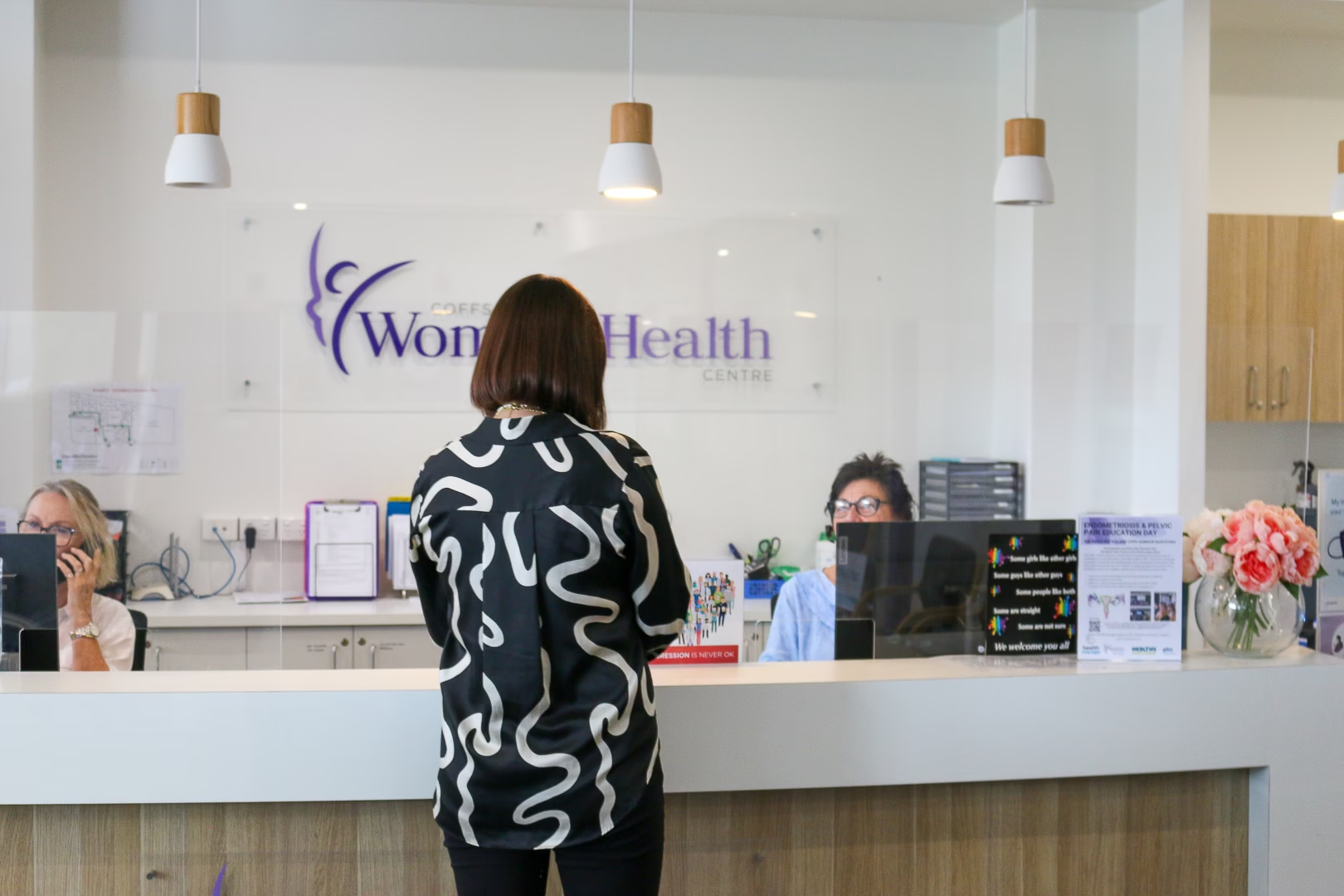
Coffs Harbour Women’s Health Centre contributed nursing and midwifery support, patient triage, pre-procedure care, emotional support, and two-way referral pathways back into the broader women’s health system
Health Voyage supported the strategic coordination and relationship stewardship that made the collaboration possible
The outcomes: more women seen, better care delivered
With nursing support in place, specialist appointment times reduced from 45 minutes to 30 – because the nurse could handle the preparation, information-giving, and follow-up that had previously fallen to the doctor. The result was a roughly 40% increase in patient throughput: from around five patients a day to eight.
But the numbers only tell part of the story. Just as important was the quality of care women received. For many, colposcopy is an anxious and unfamiliar experience. Having a nurse or midwife to explain what was going to happen, provide emotional support through the procedure, and follow up with results – faster than a busy doctor could manage – made a real difference, particularly for women from vulnerable populations.
The nurses could also triage patients, ensuring those with the most urgent needs were seen first – including women who had only ever had a self-collected cervical screen and needed further assessment before the full clinical picture was clear.
An unexpected benefit: the clinic became a referral pathway back into the Women’s Health Centre itself. Susan Hoff noted that some women coming through hadn’t known the service existed. The collaboration created visibility – and connection – in both directions.
“The Women’s Health Centre nurses were frustrated too – their patients needed a colposcopy and they had nowhere to go. So, it was an opportunity for us to work together for mutual benefit.” – Susan Hoff, District Coordinator Women’s Health, Mid North Coast Local Health District
What this model shows about how regional health works
This collaboration didn’t happen because a funding body mandated it or because a committee designed it. It happened because two organisations had an honest conversation about what was missing, who could help, and how to make it work quickly. That’s what genuine collaboration looks like – and it’s rarer than it should be.
It also built something lasting. A year of functioning as a joint service has created a proven model – established pathways, documented processes, and evidence of throughput – that now underpins the case for a permanent, hospital-employed nursing position. The collaboration was the proof of concept the system needed.
And the partnership continues to evolve. From July, the relationship reverses: a hospital nurse will be placed at the Women’s Health Centre one day a week to support a new menopause clinic – providing care navigation for women waiting to access specialist services. The same model, flipped. The same trust, deepened.
This is what Health Voyage exists to enable. Not to own every service or deliver everything ourselves, but to convene, connect and steward the relationships that make joined-up care possible in our region. We act as a connector in the system – not a competitor within it.
“Collaboration like this is not ad hoc – it is how regional health systems function effectively.” – Tazmyn Jewell, CEO Health Voyage
As long as there are gaps in regional health – and there will always be – this work continues.
Tazmyn Jewell is CEO of Health Voyage, a regional health organisation dedicated to connecting services and improving health outcomes across the Coffs Harbour region. Health Voyage is the proud lead agency of the Coffs Harbour Women’s Health Centre and works in close partnership with the Mid North Coast Local Health District.